pickle
contents
related file
- Lib/pickle.py
- Modules/_pickle.c
- Modules/clinic/_pickle.c.h
introduction
We use the pickle module to serialize and deserialize our Python objects. There are several protocol versions for pickle. The current version is 4
The pickle module will use the faster _pickle implemented in C(Modules/_pickle.c) if possible, if the _pickle module not found, the python implemented pickle(Lib/pickle.py) will be used
| Type | Implementation |
|---|---|
| None | save_none |
| bool | save_bool |
| int | save_long |
| float | save_float |
| bytes | save_bytes |
| str | save_str |
| tuple | save_tuple |
| list | save_list |
| dict | save_dict |
| set | save_set |
| frozenset | save_frozenset |
| FunctionType | save_global |
| save_reduce |
implementation
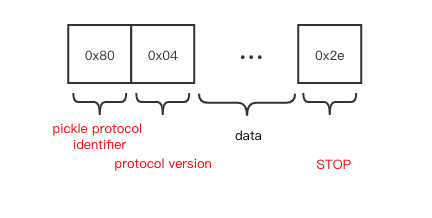
Whenever you call dump, some extra information will be added to the result
The first byte is an identifier indicate that the following binary content is encoded in “pickle protocol”
The second byte is the protocol version
The final byte is a stop symbol indicate that it’s the end of the binary content
None
NONE = b'N'   # push None

def save_none(self, obj):
	self.write(NONE)
The data is N here, with the aforementioned information added to it
>>> import pickle
>>> pickle.dumps(None)
b'\x80\x04N.'
bool
bool is similar to None
NEWTRUE        = b'\x88'  # push True
NEWFALSE       = b'\x89'  # push False

def save_bool(self, obj):
	if self.proto >= 2:
		self.write(NEWTRUE if obj else NEWFALSE)
The data here is b'\x88'(True) and b'\x89'(False)
>>> import pickle
>>> pickle.dumps(True)
b'\x80\x04\x88.'
>>> pickle.dumps(False)
b'\x80\x04\x89.'
int
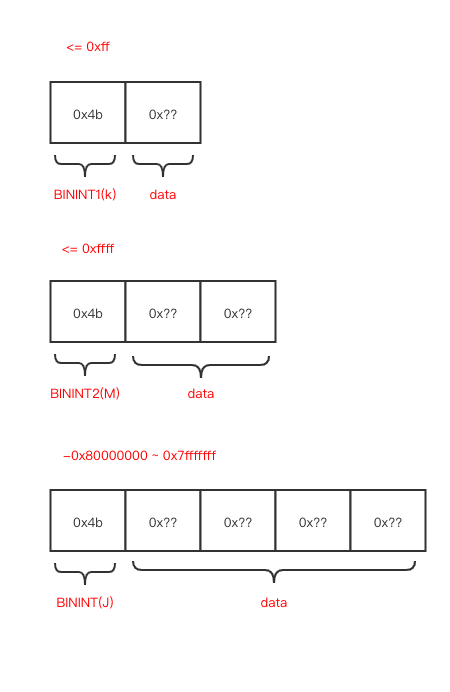
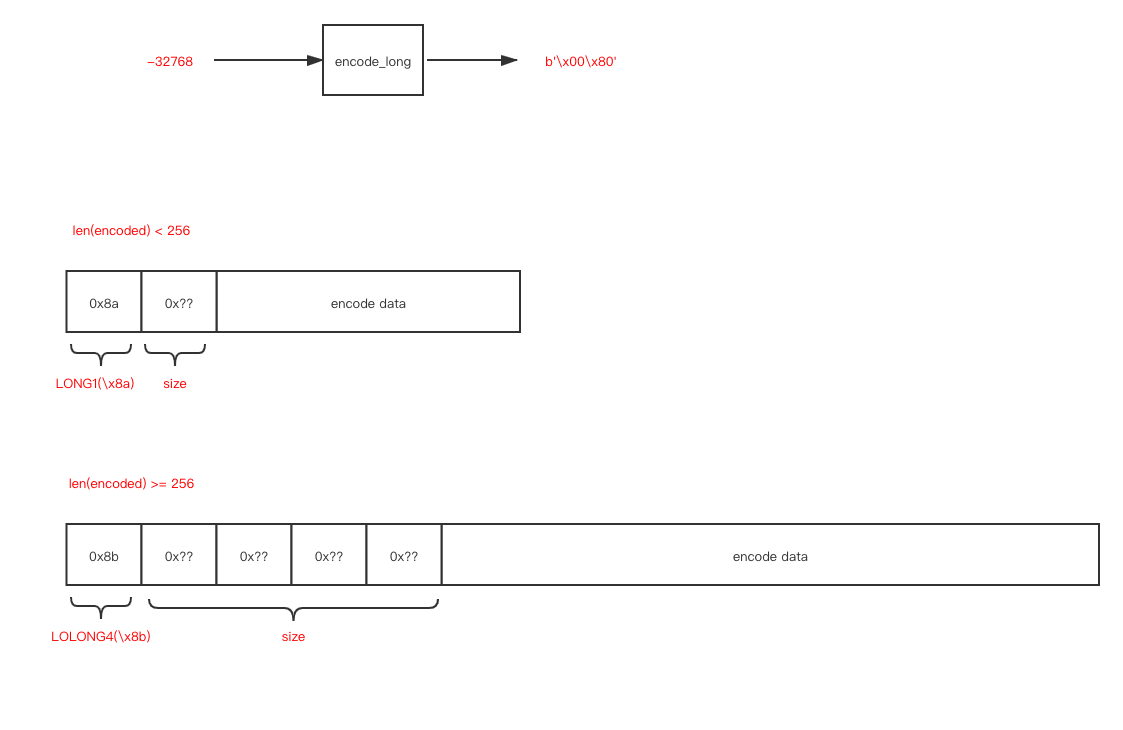
The integer will be saved in various formats according to its value
float
The float is saved in IEEE_754 standard
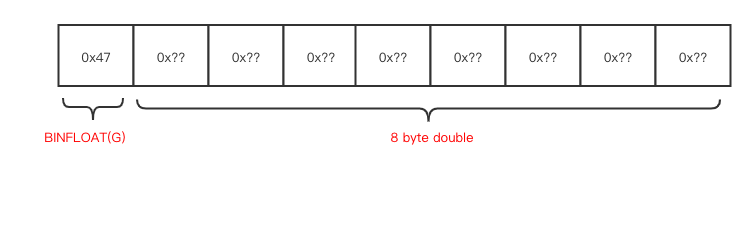
bytes
bytes object is saved directly as the data part below
The head part varies according to the data size
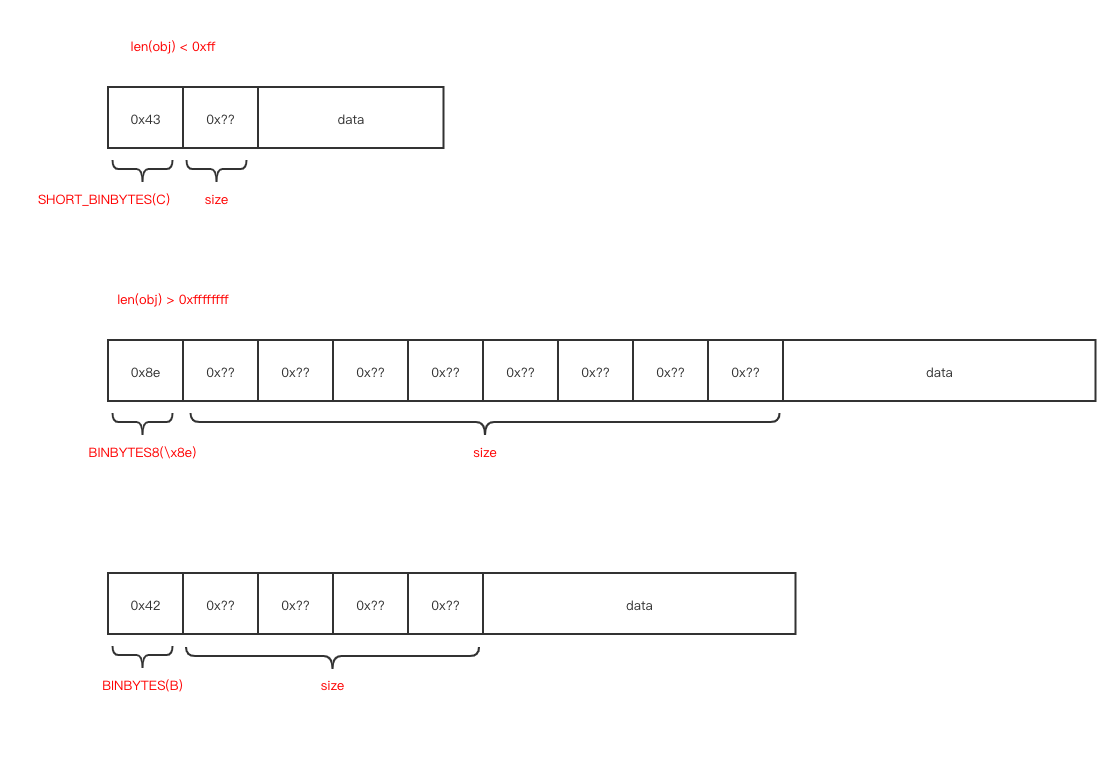
str
str is similar to bytes, except that str is encoded in utf-8 format before dump
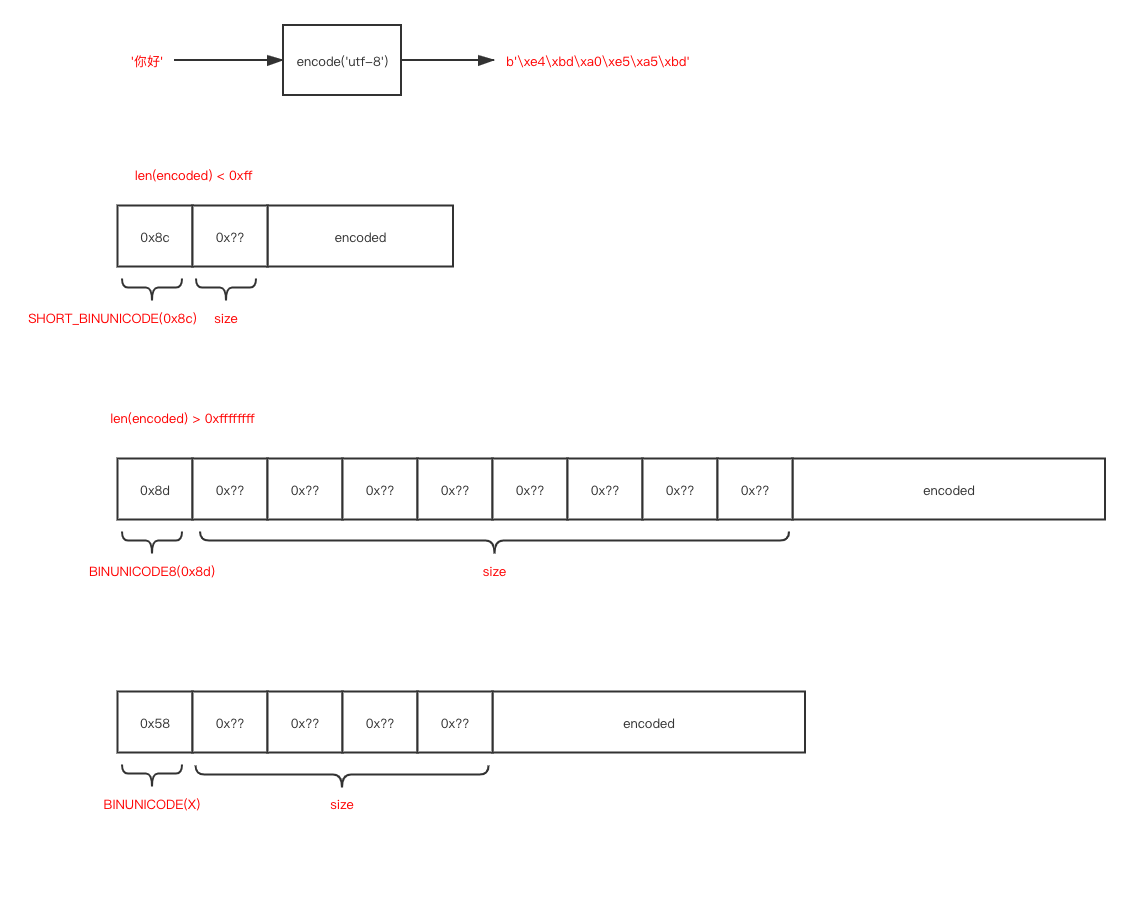
tuple
tuple is more complicated than other basic type
If the tuple is empty
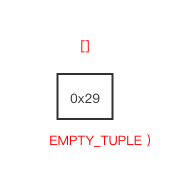
Let’s see an example
dumps(("a", "b", (2, )))
b'\x80\x04\x95\x0f\x00\x00\x00\x00\x00\x00\x00\x8c\x01a\x94\x8c\x01b\x94K\x02\x85\x94\x87\x94.'
\x80\x04 is pickle protocol and pickle version
\x95\x0f\x00\x00\x00\x00\x00\x00\x00 is frame symbol(\x95) and frame size(8 bytes) in little endian
. in last byte is the STOP symbol
Besides are the data
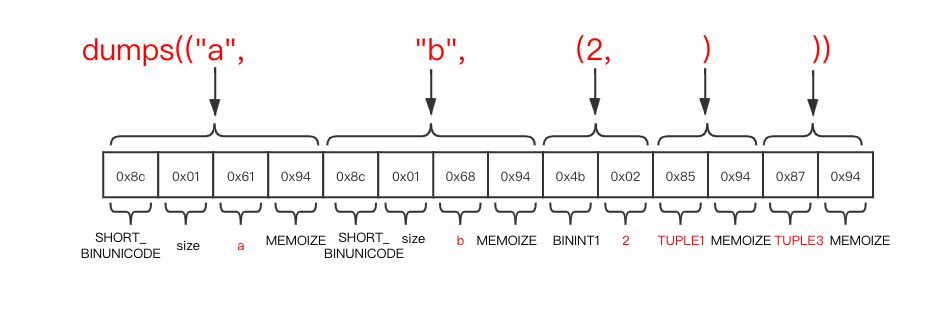
I found that dumps does not support self-referencing tuples(how to Build Self-Referencing Tuples)
list
Let’s see an example again
dumps(["a", "b", (2, )])
b'\x80\x04\x95\x11\x00\x00\x00\x00\x00\x00\x00]\x94(\x8c\x01a\x94\x8c\x01b\x94K\x02\x85\x94e.'
The first several bytes are pickle protocol, pickle version and frame size
The last byte is STOP symbol
The data can be described as (]\x94(\x8c\x01a\x94\x8c\x01b\x94K\x02\x85\x94e)
list will be dumped batch by batch(default batch size 1000)
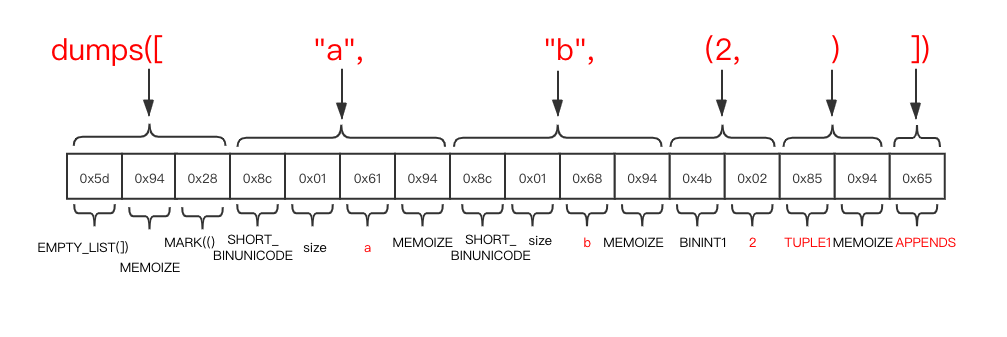
dict and set are similar to list and tuple, beginning and ending with a type symbol to indicate the type, and iterating through each object and recursively calling dump for each object
type
If what’s to be saved is a type
class A(object):
    a = "a"
    b = "b"

    def run(self):
        print(self.a, self.b)

pickle.dumps(A)
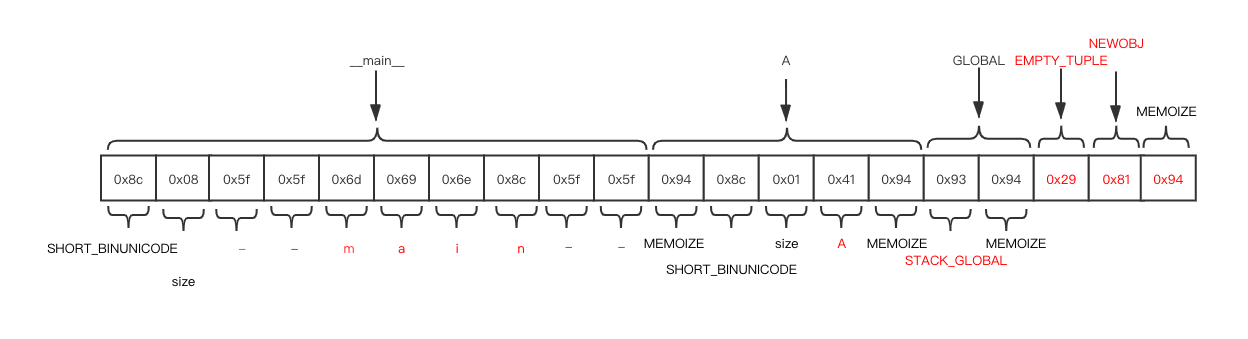
b'\x80\x04\x95\x12\x00\x00\x00\x00\x00\x00\x00\x8c\x08__main__\x94\x8c\x01A\x94\x93\x94.'
The data part is \x8c\x08__main__\x94\x8c\x01A\x94\x93\x94
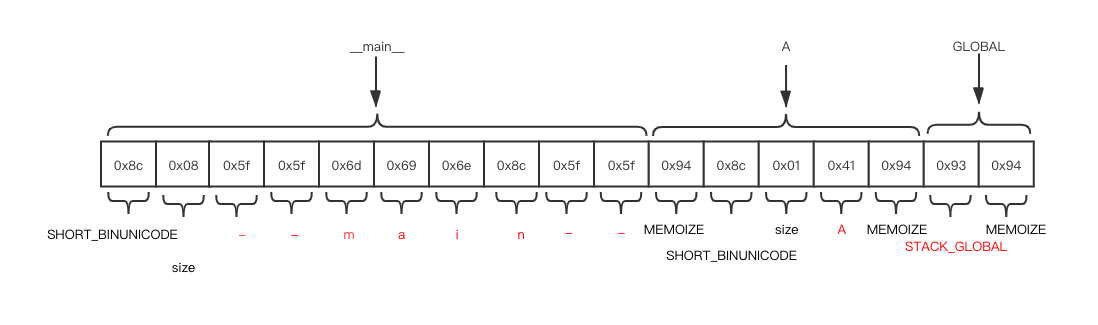
dumps(A) saves the module_name (__main__) and the object name (A) in str format
object
If what’s to be saved is an instance
a = A()
pickle.dumps(a)
b'\x80\x04\x95\x15\x00\x00\x00\x00\x00\x00\x00\x8c\x08__main__\x94\x8c\x01A\x94\x93\x94)\x81\x94.'
The data part is \x8c\x08__main__\x94\x8c\x01A\x94\x93\x94)\x81\x94
The only difference is that there is some extra information appended after the previous dumped result
A TUPLE indicate the args needed for instance call, in the current case a = A() the args is empty, so it’s an EMPTY_TUPLE
A NEWOBJ symbol indicate that it needs to call cls.__new__(cls, *args) after load the dumped result