AST TO byte code
contents
related file
-
Python/compile.c
-
Python/pythonrun.c
-
Python/symtable.c
-
Include/symtable.h
-
Python/ast_opt.c
Let’s generate the python code object from previous AST tree
The aforementioned pythonrun call stack
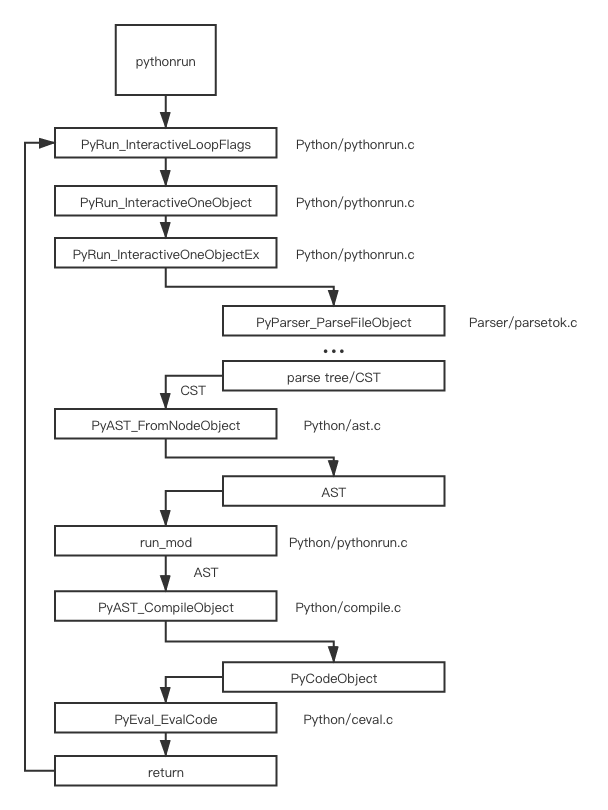
We will foucus on PyAST_CompileObject this time
PyCodeObject *
PyAST_CompileObject(mod_ty mod, PyObject *filename, PyCompilerFlags *flags,
                   int optimize, PyArena *arena)
{
    struct compiler c;
    PyCodeObject *co = NULL;
    PyCompilerFlags local_flags;
    int merged;
		// ... omit ...

    if (!_PyAST_Optimize(mod, arena, c.c_optimize)) {
        goto finally;
    }

    c.c_st = PySymtable_BuildObject(mod, filename, c.c_future);
    if (c.c_st == NULL) {
        if (!PyErr_Occurred())
            PyErr_SetString(PyExc_SystemError, "no symtable");
        goto finally;
    }

    co = compiler_mod(&c, mod);

 finally:
    compiler_free(&c);
    assert(co || PyErr_Occurred());
    return co;
}
optimize
_PyAST_Optimize will do some optimize such as constant folding
static int
fold_binop(expr_ty node, PyArena *arena, int optimize)
{
    expr_ty lhs, rhs;
    lhs = node->v.BinOp.left;
    rhs = node->v.BinOp.right;
    if (lhs->kind != Constant_kind || rhs->kind != Constant_kind) {
        return 1;
    }

    PyObject *lv = lhs->v.Constant.value;
    PyObject *rv = rhs->v.Constant.value;
    PyObject *newval;

    switch (node->v.BinOp.op) {
    case Add:
        newval = PyNumber_Add(lv, rv);
        break;
    case Sub:
        newval = PyNumber_Subtract(lv, rv);
        break;
    case Mult:
        newval = safe_multiply(lv, rv);
        break;
    case Div:
        newval = PyNumber_TrueDivide(lv, rv);
        break;
    case FloorDiv:
        newval = PyNumber_FloorDivide(lv, rv);
        break;
    case Mod:
        newval = safe_mod(lv, rv);
        break;
    case Pow:
        newval = safe_power(lv, rv);
        break;
    case LShift:
        newval = safe_lshift(lv, rv);
        break;
    case RShift:
        newval = PyNumber_Rshift(lv, rv);
        break;
    case BitOr:
        newval = PyNumber_Or(lv, rv);
        break;
    case BitXor:
        newval = PyNumber_Xor(lv, rv);
        break;
    case BitAnd:
        newval = PyNumber_And(lv, rv);
        break;
    default: // Unknown operator
        return 1;
    }
    return make_const(node, newval, arena);
}
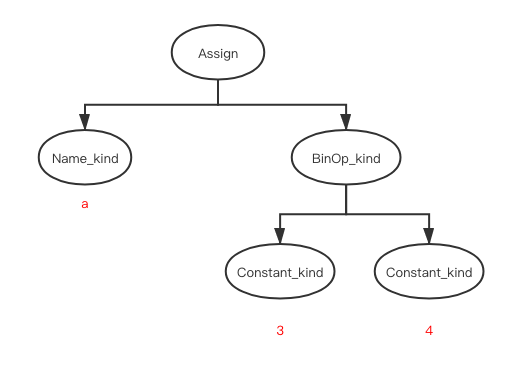
For example
a = 3 + 4
The AST is
After fold_binop, it becomes
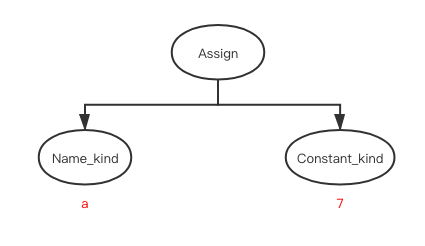
The constant folding will also
-
expand binary op(as above)
- expand your unary op(
not/is/isnot) - change you list literal to tuple
- fetch the constant sub index
- etc …
symtable
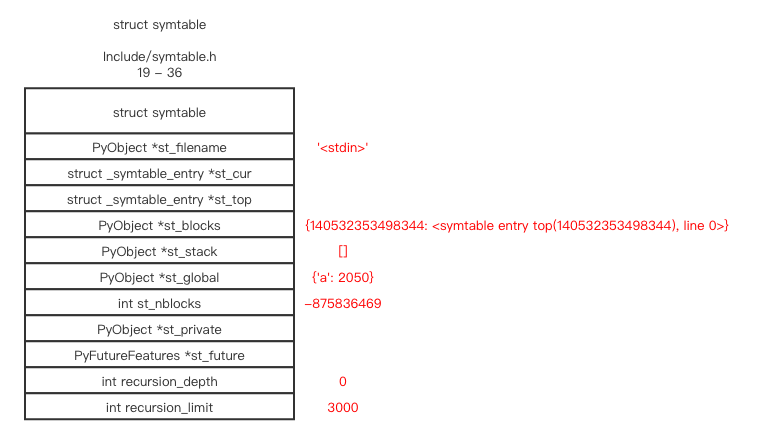
After _PyAST_Optimize, the PySymtable_BuildObject will traverse the AST and add stores the the function/class/name definition to a Python dict object
CodeObject
compiler_mod will traverse the AST, generate the appropriate byte code instruction and helper data, finally generate and return aPyCodeObject
static int
compiler_visit_expr1(struct compiler *c, expr_ty e)
{
      // ...
      case Constant_kind:
        ADDOP_LOAD_CONST(c, e->v.Constant.value);
        break;
      // ...
}

static int
compiler_addop_load_const(struct compiler *c, PyObject *o)
{
    // add the constant value to a dictionary object: c->u->u_consts, returns the index after converted to list(offset of arg list)
    Py_ssize_t arg = compiler_add_const(c, o);
    if (arg < 0)
        return 0;
    // add the `LOAD_CONST arg` to the next instruction
    return compiler_addop_i(c, LOAD_CONST, arg);
}

// Below functions can be found in Python/compile.c
static int
compiler_addop_i(struct compiler *c, int opcode, Py_ssize_t oparg)
{
    struct instr *i;
    int off;

    // ...

    off = compiler_next_instr(c, c->u->u_curblock);
    if (off < 0)
        return 0;
    i = &c->u->u_curblock->b_instr[off];
    i->i_opcode = opcode;
    i->i_oparg = Py_SAFE_DOWNCAST(oparg, Py_ssize_t, int);
    compiler_set_lineno(c, off);
    return 1;
}

static Py_ssize_t
compiler_add_const(struct compiler *c, PyObject *o)
{
    PyObject *key = merge_consts_recursive(c, o);
    if (key == NULL) {
        return -1;
    }

    Py_ssize_t arg = compiler_add_o(c, c->u->u_consts, key);
    Py_DECREF(key);
    return arg;
}

static Py_ssize_t
compiler_add_o(struct compiler *c, PyObject *dict, PyObject *o)
{
    PyObject *v;
    Py_ssize_t arg;

    v = PyDict_GetItemWithError(dict, o);
    if (!v) {
        if (PyErr_Occurred()) {
            return -1;
        }
        arg = PyDict_GET_SIZE(dict);
        v = PyLong_FromSsize_t(arg);
        if (!v) {
            return -1;
        }
        if (PyDict_SetItem(dict, o, v) < 0) {
            Py_DECREF(v);
            return -1;
        }
        Py_DECREF(v);
    }
    else
        arg = PyLong_AsLong(v);
    return arg;
}
The constants are stored in dict format, key represent the constant PyObject, value is the offset {'a': 0}
It will be converted to a list object in the order of value in Python/compile.c->consts_dict_keys_inorder
Finally, the Python/compile.c->makecode converts the compiled instrcutions and helper data to a newly create PyCodeObject
  1           0 LOAD_CONST               0 (7)
              2 STORE_NAME               0 (a)
              4 LOAD_CONST               1 (None)
              6 RETURN_VALUE